


The best BrowserStack alternative depends on the gap you need to fill. This guide compares 12 options as of November 2026, from Katalon TestCloud with Studio to Sauce Labs, TestMu AI, mobile device clouds, and free self-hosted tools, with dated prices and when to choose each.
The best BrowserStack alternative depends on the gap you need to fill: Katalon TestCloud, paired with Katalon Studio, suits teams that want to author tests and run them on cloud browsers and real devices in one workflow, while Sauce Labs and TestMu AI (formerly LambdaTest) are the closest like-for-like cloud grids. For mobile-only device testing, look at Kobiton, AWS Device Farm, or Firebase Test Lab, and for a free route, Selenium Grid or Playwright on your own infrastructure.
This guide compares 12 BrowserStack alternatives as of November 2026, grouped by the job they do, with prices taken from each vendor's own site.
What BrowserStack offers and why teams look elsewhere
BrowserStack is a cloud platform for testing websites and mobile apps on real browsers and devices. As of November 2026, its pricing page lists Live (manual testing) from $12.50 a month on the Freelancer plan, or $29 a month per user for the Desktop plan, and Automate from $99 a month per parallel test, all billed annually. App Live, App Automate, Percy visual testing, Low Code Automation, Test Management, Accessibility Testing, and Load Testing are priced as separate products. BrowserStack also sells AI agents across those products and a Team Ultimate pack that bundles 15 products.
Teams usually start looking for an alternative for one of these reasons:
- Cost at scale. Automate is priced per parallel, so adding parallel runs, or adding products such as App Automate, raises the bill.
- Separate products for separate jobs. Authoring, execution, test management, and visual testing are different line items unless you buy a bundle.
- A narrower need. Some teams only need Android and iOS devices, or only need a few browsers in CI, and pay for more than they use.
- Control. Some teams want to run tests on their own machines, or need a private setup for applications behind a firewall.
What to look for in a BrowserStack alternative
The tools below fall into four groups: cloud browser and device grids, mobile device clouds, AI and low-code test platforms, and free tools you host yourself. Before you compare them, decide what matters most to you:
- Coverage: desktop browsers only, or real iOS and Android devices too?
- Test authoring: do you already have Selenium, Playwright, or Appium tests, or do you also need a way to build them?
- Framework support: will it run the tests you already have without a rewrite?
- Pricing model: per user, per parallel, per device minute, or by credits?
- Private access: can it reach staging environments behind your firewall?
- Reporting: pass and fail results only, or history, logs, and failure analysis?
For a broader look at the practice itself, see our guide to cross-browser testing.
Cloud browser and device grids
1. Katalon TestCloud (with Katalon Studio)

Best for: teams that want to build tests and run them on cloud browsers and real devices without maintaining a grid.
Katalon TestCloud runs automated and live tests in parallel on cloud browsers and real devices. It covers Chrome, Firefox, Safari, and Edge on Windows and macOS, and real iOS and Android devices for both live testing and automated runs. Device features include network throttling, location and biometric simulation, and camera injection for QR and barcode flows. A private tunnel and IP allowlisting let TestCloud reach staging sites behind your firewall.
TestCloud pairs with Katalon Studio, Katalon's test automation IDE. In Studio you can record tests, build them from keywords, or write them in Groovy or Java for web, mobile, API, and (on paid plans) Windows desktop applications. Web and mobile suites can then run on TestCloud. According to the TestCloud page, you can also bring Playwright, Selenium, and Appium tests. On a paid plan (Professional or Enterprise), Studio includes AI self-healing, which retries alternative locators when the UI changes, and AI analysis of failure root causes.
Runs can be triggered from CI with a Katalon Runtime Engine (KRE) add-on on a paid plan (the Free plan has no command-line or CI execution), and results can be sent to Katalon TestOps for reporting. If tests need to stay inside your own infrastructure, KRE runs the same suites on your own machines.
To be candid about the trade-off: BrowserStack, Sauce Labs, and TestMu AI advertise larger device catalogs. If you need to validate on a long list of older device and OS combinations, check that TestCloud covers them before you commit. Studio can also run tests on Selenium Grid, BrowserStack, Sauce Labs, and TestMu AI through remote execution, so you aren't locked into one cloud.
Pricing (as of November 2026): TestCloud is a paid add-on that works with any Studio plan, including Free; see Katalon pricing for current terms. TestCloud also has its own free trial. Studio has a Free plan, Professional at $1,800 per seat per year (about $150 a month, billed annually), and a custom Enterprise plan, with a 30-day free trial.
Best fit: teams that want authoring, cloud execution, and reporting from one vendor, especially teams that mix testers who code with testers who don't. For a head-to-head, read TestCloud vs BrowserStack.
2. Sauce Labs

Best for: enterprise teams that want a large real device and browser cloud, with AI test authoring on Enterprise plans.
Sauce Labs is a long-established cloud testing platform. It runs Selenium, Appium, Playwright, and Cypress tests on desktop browsers, virtual devices, and real devices. Sauce Labs is an independent company and is not part of Tricentis.
The old view that Sauce Labs only runs tests you write elsewhere is out of date. As of November 2026, its site lists Sauce AI for Test Authoring, available on Enterprise plans, which turns intent described in plain language into test cases, and the AURA platform, which Sauce Labs describes as a closed-loop agentic platform that writes, runs, analyzes, and heals tests. Sauce AI for Insights (also Enterprise) covers test analytics and failure analysis.
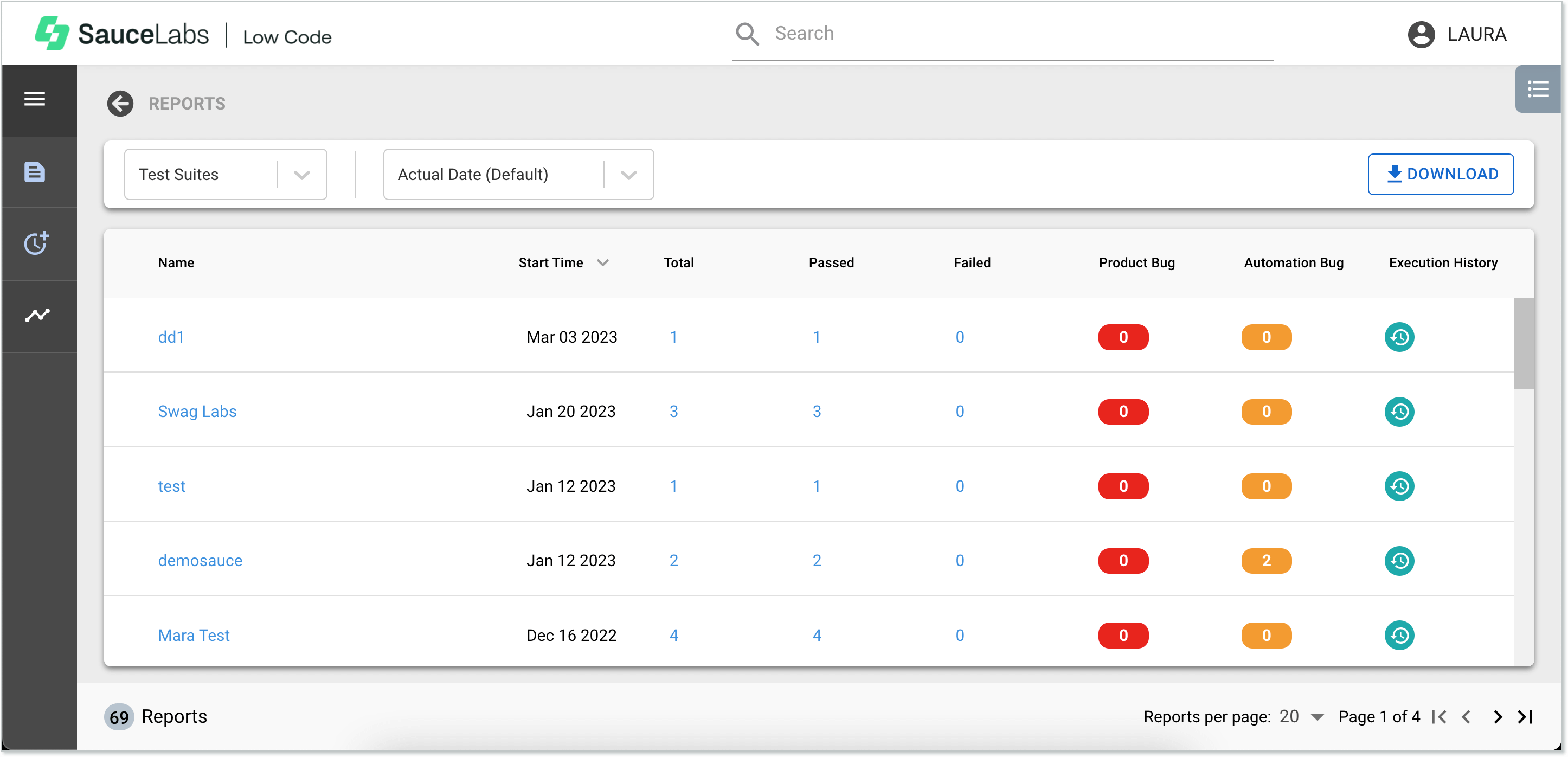
Pricing (as of November 2026): Live Testing from $39 a month billed annually ($49 month to month), Virtual Device Cloud from $149 a month ($199), Real Device Cloud from $199 a month ($249), and Enterprise by quote.
Best fit: enterprise teams with established automation frameworks that want a close match to BrowserStack's device cloud. See our Katalon vs Sauce Labs comparison for detail.
3. TestMu AI (formerly LambdaTest)

Best for: cost-conscious teams that want a broad cloud grid with fast parallel execution.
LambdaTest renamed itself TestMu AI in January 2026, and lambdatest.com now redirects to testmuai.com. It is a direct BrowserStack competitor: live and automated testing on cloud browsers, a real device cloud, and HyperExecute for orchestrating fast parallel runs.
TestMu AI now also covers authoring and management. KaneAI creates tests from plain-language instructions, and Test Manager handles test case management. SmartUI covers visual testing.
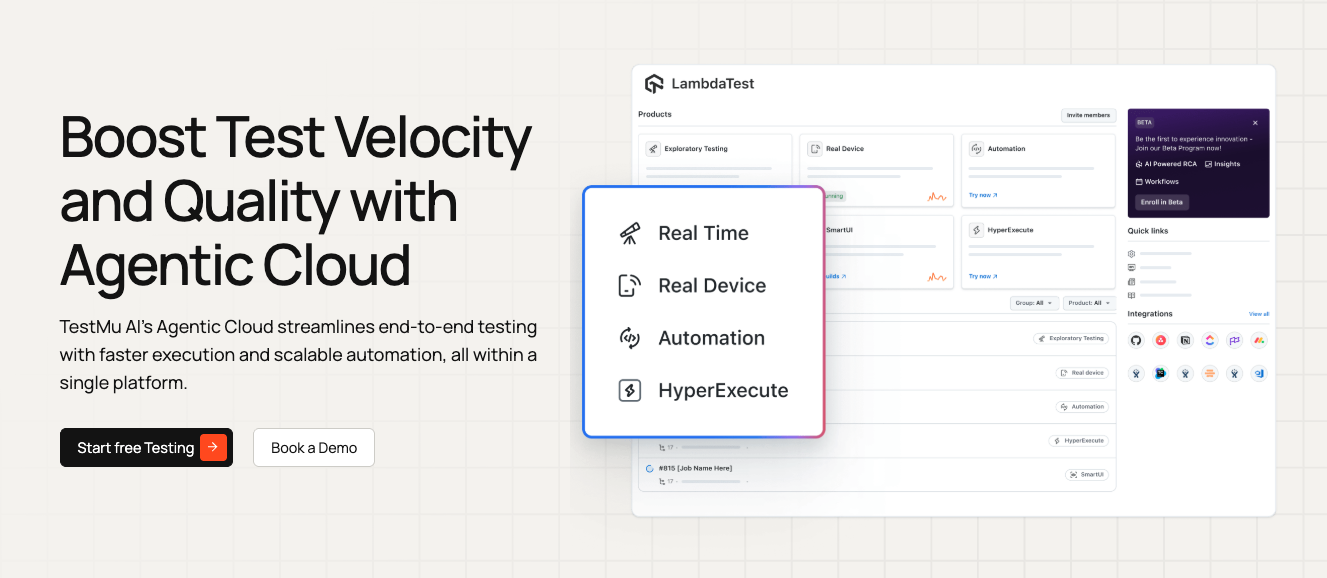
Pricing (as of November 2026): a free plan for live testing, Live from $15 a month, web automation from $29 a month, KaneAI from $17 a month, and Test Manager Premium at $49 a month, all billed annually. Real device and enterprise plans cost more.
Best fit: teams whose main constraint is execution cost and parallel capacity, and teams that want AI authoring from the same vendor as their grid.
4. Perfecto
Best for: large enterprises in regulated industries that need real devices, browsers, and desktop in one cloud.
Perfecto, from Perforce, is an enterprise testing cloud for web, mobile, and desktop applications across a broad range of real devices. As of November 2026, Perforce positions Perfecto around AI test creation. Enterprise deployment options and support are a focus.
Pricing: by quote (as of November 2026).
Best fit: enterprises that want a managed device cloud with enterprise controls and don't need self-serve pricing.
TestingBot and TestGrid are two more cloud grids worth a look if none of the above fits.
Mobile device clouds
5. HeadSpin
Best for: teams that need to test mobile app performance across real devices, networks, and locations.
HeadSpin is a real device cloud for mobile app testing, with a focus on app performance and network conditions alongside functional results.
Pricing: by quote; contact HeadSpin (as of November 2026).
Best fit: teams where network conditions, location, and performance matter as much as functional results.
6. Kobiton
Best for: mobile teams that want real device testing with predictable monthly minutes.
Kobiton is a real device cloud focused on mobile apps, with manual and automated testing on iOS and Android devices.
Pricing (as of November 2026): Startup from $83 a month and Accelerate from $399 a month (billed monthly; 500 and 3,000 minutes), Scale at $9,000 a year, and Enterprise by quote. A free trial is available.
Best fit: mobile-first teams that don't need desktop browser coverage.
7. AWS Device Farm
Best for: teams already on AWS that want to pay per device minute.
AWS Device Farm runs automated and manual tests on real Android and iOS devices hosted by AWS, and fits naturally into AWS-based pipelines. It also offers desktop browser testing, billed per instance minute.
Pricing (as of November 2026): $0.17 per device minute pay as you go, after a one-time free trial (currently 1,000 device minutes as a limited-time offer; normally 250). Unmetered testing starts at $250 a month per device slot.
Best fit: AWS teams with occasional or bursty mobile test runs, where per-minute billing beats a monthly plan.
8. Firebase Test Lab
Best for: Android and iOS app teams that want a low-cost way to run tests on Google-hosted devices.
Firebase Test Lab runs your app tests on physical and virtual devices in Google data centers, and integrates with Android Studio, the Firebase console, and the gcloud command line.
Pricing (as of November 2026): the free Spark plan allows a small number of test runs per day (5 on physical devices and 10 on virtual devices). On the Blaze plan, the first 30 minutes a day on physical devices and 60 on virtual devices are free, then $5 an hour per physical device and $1 an hour per virtual device.
Best fit: app developers who want device coverage in CI at a low cost. If you are also weighing mobile frameworks, see our list of Appium alternatives.
AI and low-code test platforms
9. mabl

Best for: teams that want low-code authoring, auto-healing, and cloud execution in a single SaaS platform.
mabl is a low-code test automation platform for web, mobile (iOS and Android, through an add-on), API, accessibility, and performance testing. It runs tests in its own cloud across Chrome, Firefox, Safari (WebKit), and Edge, and its auto-healing updates tests as the application changes.
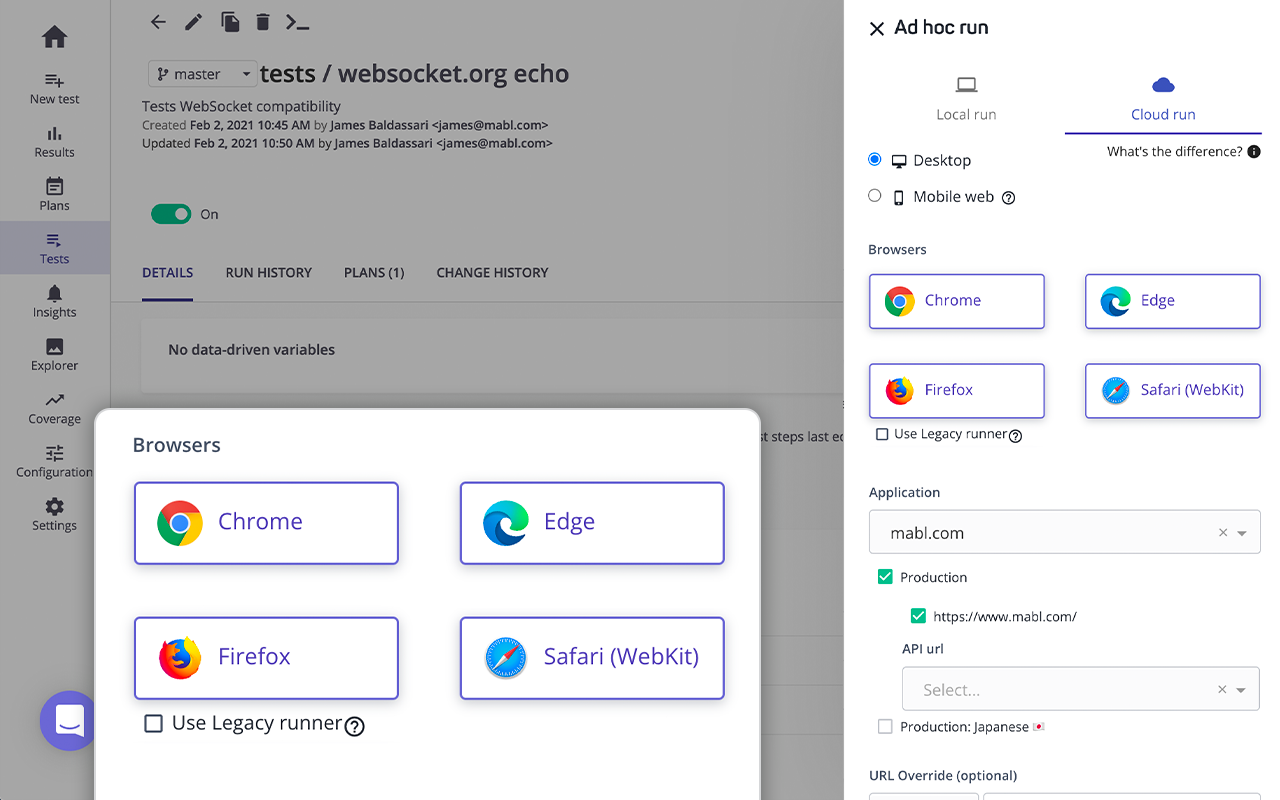
mabl advertises unlimited cloud concurrency, but cloud test runs consume credits, so more cloud runs cost more. Local and CI runs are unlimited. mabl does not cover Windows desktop applications.
Pricing: custom, with a free trial (as of November 2026).
Best fit: web-focused teams whose main problem is brittle tests rather than device breadth.
10. Ranorex

Best for: teams testing Windows desktop applications alongside web and mobile.
Ranorex Studio, now part of Sembi's set of tools, is a commercial test automation tool with a recorder and a full scripting environment. Its strength is Windows desktop application testing, which BrowserStack doesn't cover. It is not a cloud grid: tests run on your own machines or agents.
Pricing: by quote, with a free trial (as of November 2026).
Best fit: teams whose product includes Windows desktop components. Katalon Studio also covers Windows desktop testing on its paid plans.
Free and self-hosted alternatives
11. Playwright

Best for: developer-led teams that want code-first web automation and are happy to run their own infrastructure.
Playwright is an open-source framework from Microsoft, not an execution cloud. It drives Chromium, Firefox, and WebKit, with auto-waiting, network interception, and a Trace Viewer for debugging. It also supports API testing out of the box. It doesn't test native iOS or Android apps. Mobile web is mostly through emulation, with experimental support for Chrome on real Android devices and for Electron desktop apps.
Teams usually run Playwright in their own CI (GitHub Actions, Jenkins, or GitLab CI) and add a cloud grid when they need real devices or more browsers.
Pricing: free and open source.
Best fit: developer teams focused on modern web apps who want full control in code.
12. Selenium Grid

Best for: teams with DevOps capacity that want parallel browser testing at no license cost.
Selenium Grid is the open-source way to run WebDriver tests remotely and in parallel on machines you control. Grid 4 has official Docker images and a Helm chart for Kubernetes. Cloud grids such as BrowserStack accept the same WebDriver tests, so moving between a self-hosted Grid and a cloud is mostly configuration.
You get full control and no per-parallel fees, but you build and maintain the infrastructure, and your coverage is limited to the browsers and devices you host. There are no built-in analytics, authoring, or test management.
Pricing: free and open source; you pay for the infrastructure.
Best fit: large teams with high test volumes where cloud per-parallel pricing is hard to justify.
BrowserStack alternatives compared
The table summarizes each option as of November 2026. Prices are starting list prices from each vendor's site, billed annually unless noted, and change often, so check before you buy.
Tool | Type | Real mobile devices | Test authoring | Starting price (as of November 2026) |
|---|---|---|---|---|
BrowserStack (for reference) | Cloud grid | Yes | Yes, Low Code Automation | Live from $12.50 a month; Automate from $99 a month |
Katalon TestCloud with Katalon Studio | Cloud grid plus test automation IDE | Yes, iOS and Android | Yes, in Studio (record, keywords, or code) | TestCloud is an add-on; Studio Professional $1,800 per seat per year (pricing) |
Sauce Labs | Cloud grid | Yes | Yes, Sauce AI for Test Authoring (Enterprise) | Live from $39 a month |
TestMu AI (formerly LambdaTest) | Cloud grid | Yes | Yes, KaneAI | Live from $15 a month; free plan |
Perfecto | Enterprise testing cloud | Yes | Yes, AI test creation | Quote |
HeadSpin | Mobile device and performance cloud | Yes | No, runs your tests | Quote |
Kobiton | Mobile device cloud | Yes | No, runs your tests | $83 a month, billed monthly |
AWS Device Farm | Mobile device cloud (plus desktop browsers) | Yes | No, runs your tests | $0.17 per device minute |
Firebase Test Lab | Mobile device cloud | Yes | No, runs your tests | Free Spark quota; Blaze $5 an hour per physical device after free daily minutes |
mabl | Low-code SaaS platform | Through a mobile add-on | Yes, low-code | Custom |
Ranorex | Desktop, web, and mobile automation tool | Through your own devices | Yes, recorder and code | Quote |
Playwright | Open-source framework | Mostly emulation (real Android Chrome is experimental) | Code only | Free |
Selenium Grid | Open-source self-hosted grid | Only devices you host | Code only | Free, plus infrastructure |
How to choose a BrowserStack alternative
Most teams evaluating BrowserStack alternatives are solving one of a few problems. Match the option to the problem:
- Stay with BrowserStack if you need its device catalog, already use several of its products, and the cost works for your volume. A bundle such as its Team Ultimate pack may cost less than buying products one by one.
- Choose Sauce Labs or TestMu AI if you want the closest like-for-like cloud grid. TestMu AI tends to be the lower-cost entry point; Sauce Labs and Perfecto suit enterprises that want more controls and support.
- Choose Kobiton, AWS Device Farm, Firebase Test Lab, or HeadSpin if you only test mobile apps and don't need desktop browsers.
- Choose Selenium Grid or Playwright if license cost is the constraint and you have the engineering time to run your own infrastructure.
- Choose mabl or Ranorex if test authoring is the bigger problem, or if you need Windows desktop coverage.
- Choose Katalon TestCloud with Katalon Studio if you want to build and run tests with one vendor, have a team that mixes coders and testers who don't code, or need web, mobile, API, and desktop tests in one project, with cloud execution for web and mobile when you need it.
Whichever you pick, run a short trial with your own test suite, including a test that reaches a staging site, before you commit.
Frequently asked questions
It depends on the gap. As of November 2026, Sauce Labs and TestMu AI (formerly LambdaTest) are the closest cloud grids, Kobiton and AWS Device Farm suit mobile-only teams, and Selenium Grid or Playwright are free if you host them. Katalon TestCloud with Katalon Studio suits teams that want authoring and cloud execution from one vendor.
Yes. Selenium Grid and Playwright are free and open source, but you run and maintain the infrastructure yourself. Firebase Test Lab has a free daily quota for Android and iOS app tests, TestMu AI has a free plan for live testing, and AWS Device Farm offers a one-time free trial of device minutes.
The most common complaints are cost and fragmentation. As of November 2026, Automate is priced per parallel test, and live testing, app testing, visual testing, low-code authoring, and test management are separate products unless you buy a bundle. Teams with narrow needs, such as mobile only, can end up paying for more than they use.
BrowserStack Low Code Automation lets you create tests by recording and editing steps without writing code, then run them on BrowserStack's cloud. Several alternatives offer similar authoring: Katalon Studio records tests and builds them from keywords, Sauce Labs has Sauce AI for Test Authoring on Enterprise plans, TestMu AI has KaneAI, and mabl is a low-code platform.
Yes. LambdaTest renamed itself TestMu AI in January 2026, and lambdatest.com now redirects to testmuai.com. The company still offers its cloud browser grid, real device cloud, and HyperExecute, and has added KaneAI for AI test authoring and Test Manager for test case management. Older reviews and comparisons still use the LambdaTest name.
BrowserStack uses BrowserStack Local, a tunnel from your machine to its cloud. Most cloud alternatives offer the same: Sauce Labs has Sauce Connect, TestMu AI has the TestMu AI Tunnel, and Katalon TestCloud has a private tunnel with IP allowlisting. Self-hosted Selenium Grid or Playwright reach internal sites directly.




Test everything. Ship with confidence.
From generating test cases to spotting failures, Katalon's AI works across your entire pipeline, automatically.
